Building Asterism: Your Digital Commonplace Book
Even your “second brain” needs a moment to reflect

You’re on the train on your way to meet up with a friend, and you’re listening to a podcast. You hear a quote that echoes in your mind. It’s ephemeral, and you don’t want to forget it. You open your notes app and type the quote to the best of your memory into your notes, one of hundreds. You get off at your stop. You already forget the one-liner by the time you see your friend. You have a faint impression of feeling more inspired that morning.
You’re at a panel, and one of the speakers gives advice that invigorates you. You hold it in your head, but you can’t write as fast as you can remember. You pull out your notebook and transcribe 80% of what you remembered. It’s ok. All that matters is you got the gist of it.
You’re finishing a book, and you highlight the final quote. You place your book back on your bookshelf, forgetting that you personally don’t read the same book twice.
Why Did I Create Asterism?
I was that person in those opening scenes, with the notes app full of quotes and the journal with transcriptions, waiting to be remembered. The friction was real enough that I stopped waiting for someone else to solve it and started building something myself.
As I got deeper into the world of Personal Knowledge Management (PKM) and digital commonplace books, I realized the problem wasn’t just mine. People were using multiple apps to create something that should feel simple, while others had collected dozens of notes without a system to return to them. The tools existed, but none of them quite fit.
That’s when I knew Asterism wasn’t just a personal project. I wrote about it, talked to people, and kept hearing the same thing back: the ideas are there, but they go nowhere. That’s the gap I’m trying to close.
What is Asterism?
Asterism is neither a second brain nor a productivity app. It isn’t asking you to build a system, maintain a tagging hierarchy, or feel guilty about your inbox.
Most tools in this space are obsessed with organization. They want you to file before you’ve finished thinking or optimize before you’ve even decided what matters. The substance of what you’ve collected gets buried under the overhead of maintaining the collection itself. You save the quote or the highlight, and then what? It sits there. Your book becomes a treasure chest you never open.
Asterism is built around the idea that capturing and rediscovering your ideas is itself a meaningful practice. The commonplace book has been around for centuries. da Vinci kept one. So did Marcus Aurelius and Virginia Woolf. The act of writing down what resonates with you and sitting with it over time is how ideas become wisdom.
That’s what Asterism is trying to be. A place to store what catches your attention (a quote, a sketch, a voice note on a morning walk, a highlight from something you read) and a way to find your way back to it when you’re ready.
Cultivate inspiration, not optimize workflows.
How It Works
Asterism was made with a star theme, and there are three elements to this app.
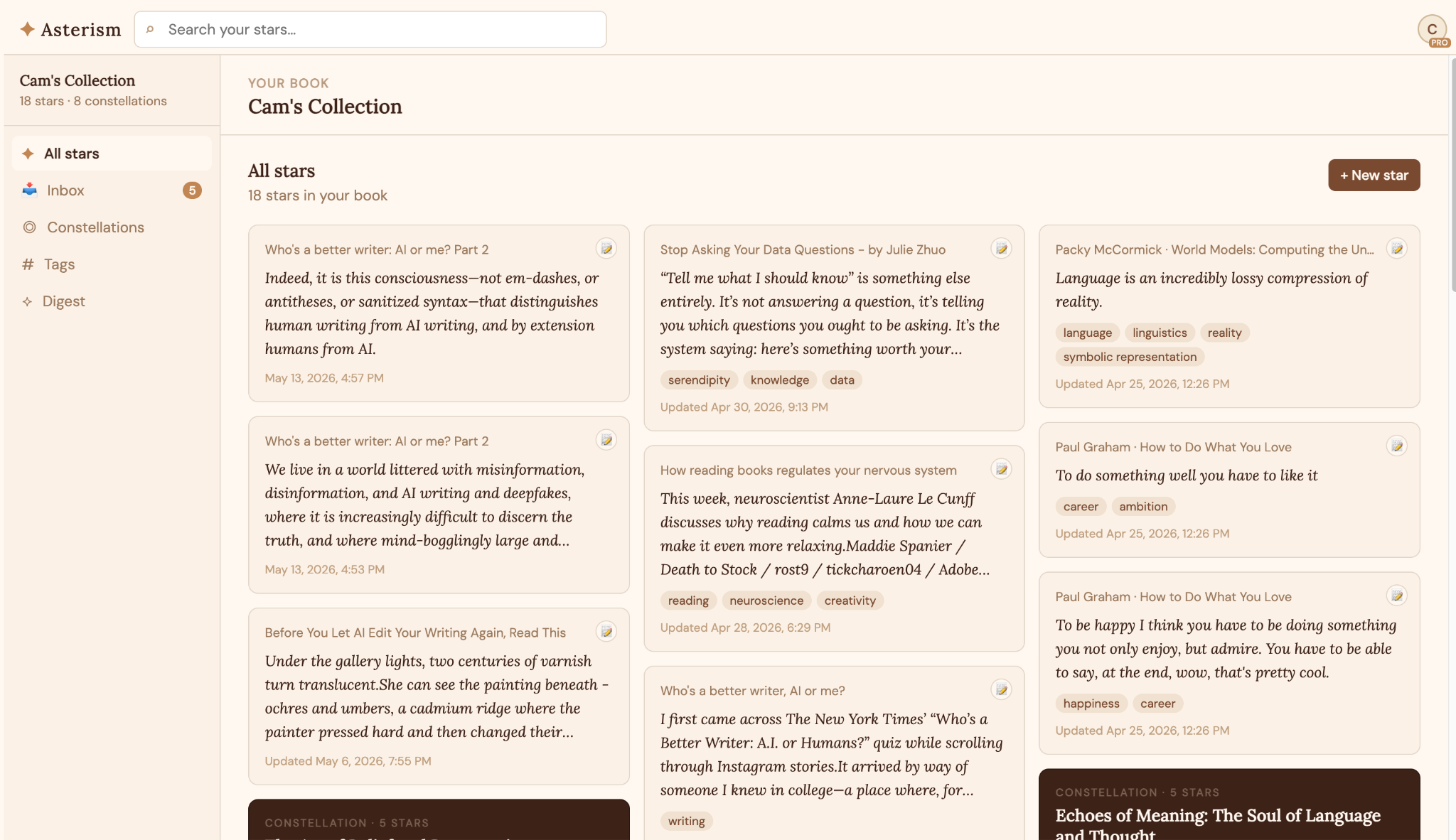
Firstly, the atomic unit is a star, a single captured idea. A star can be a typed note, an image, or a voice recording. The capture flow is designed to meet you where you are. You can add stars from the app or clip them from the web with the browser extension. You don’t need to open an app, find the right folder, and decide where something belongs before you’ve even finished the thought.
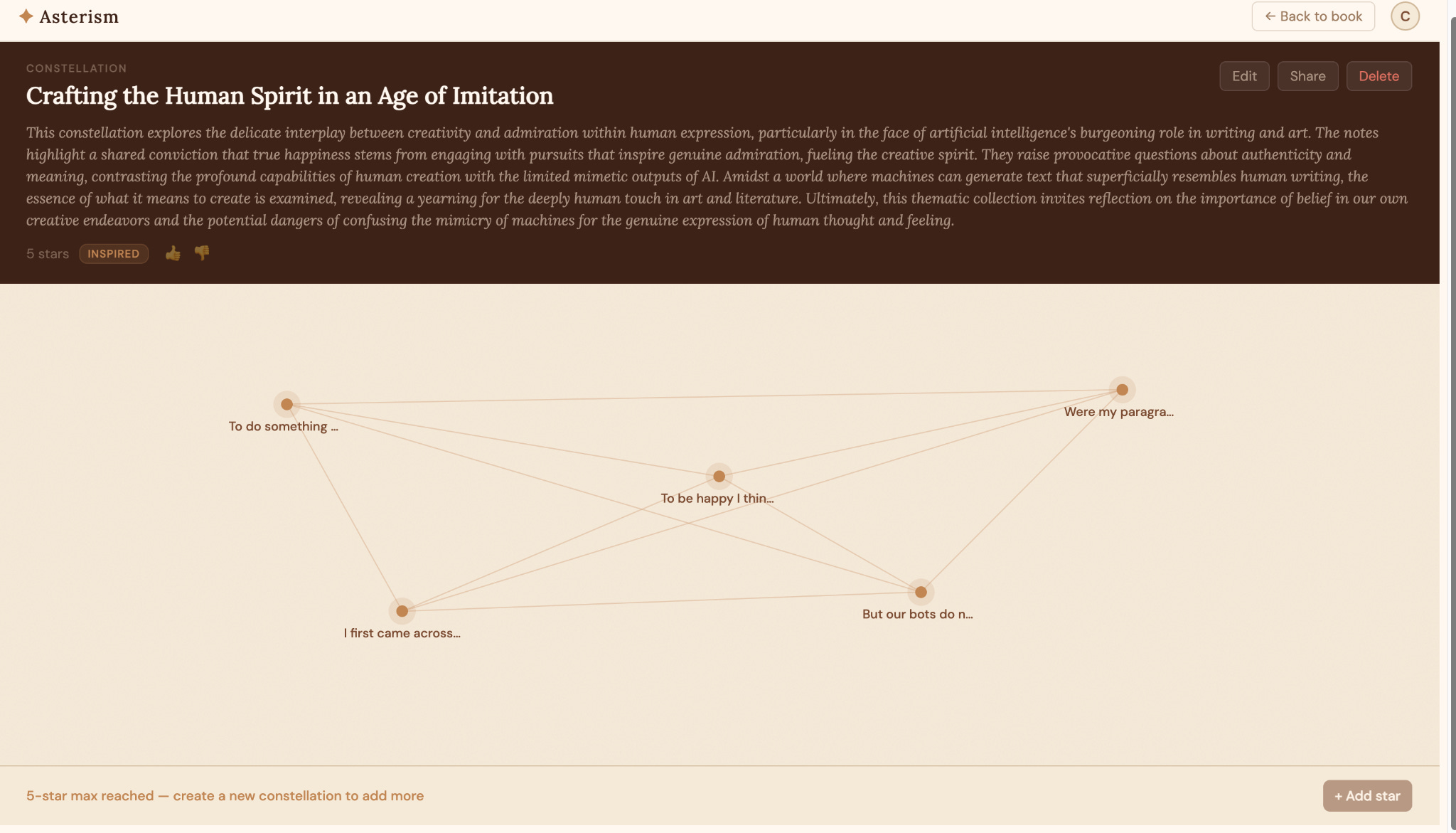
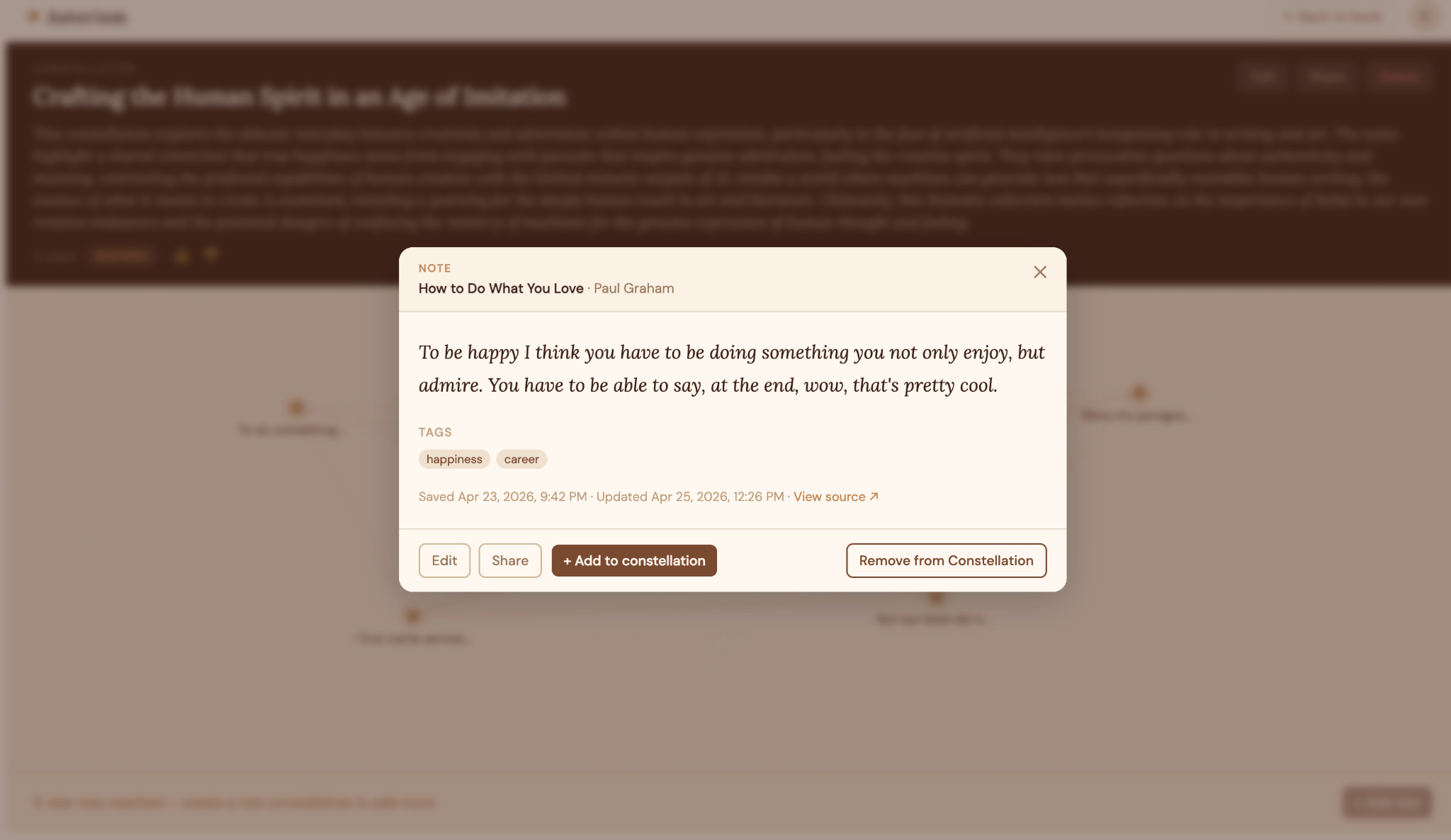
Once you have stars, you can group them into constellations, which are themes, topics, or threads of thinking you’re following. You make them, you name them, and you decide what belongs. Asterism can suggest a constellation if you want a nudge. It’ll look across your stars and offer a grouping it thinks is interesting, but it’s always just a suggestion. You’re in control of your creative thinking.
The third piece is the Serendipity Digest, which is a compilation of resurfaced stars paired with newer ones that share a theme. It sends on an adaptive cadence so it doesn’t feel spammy.
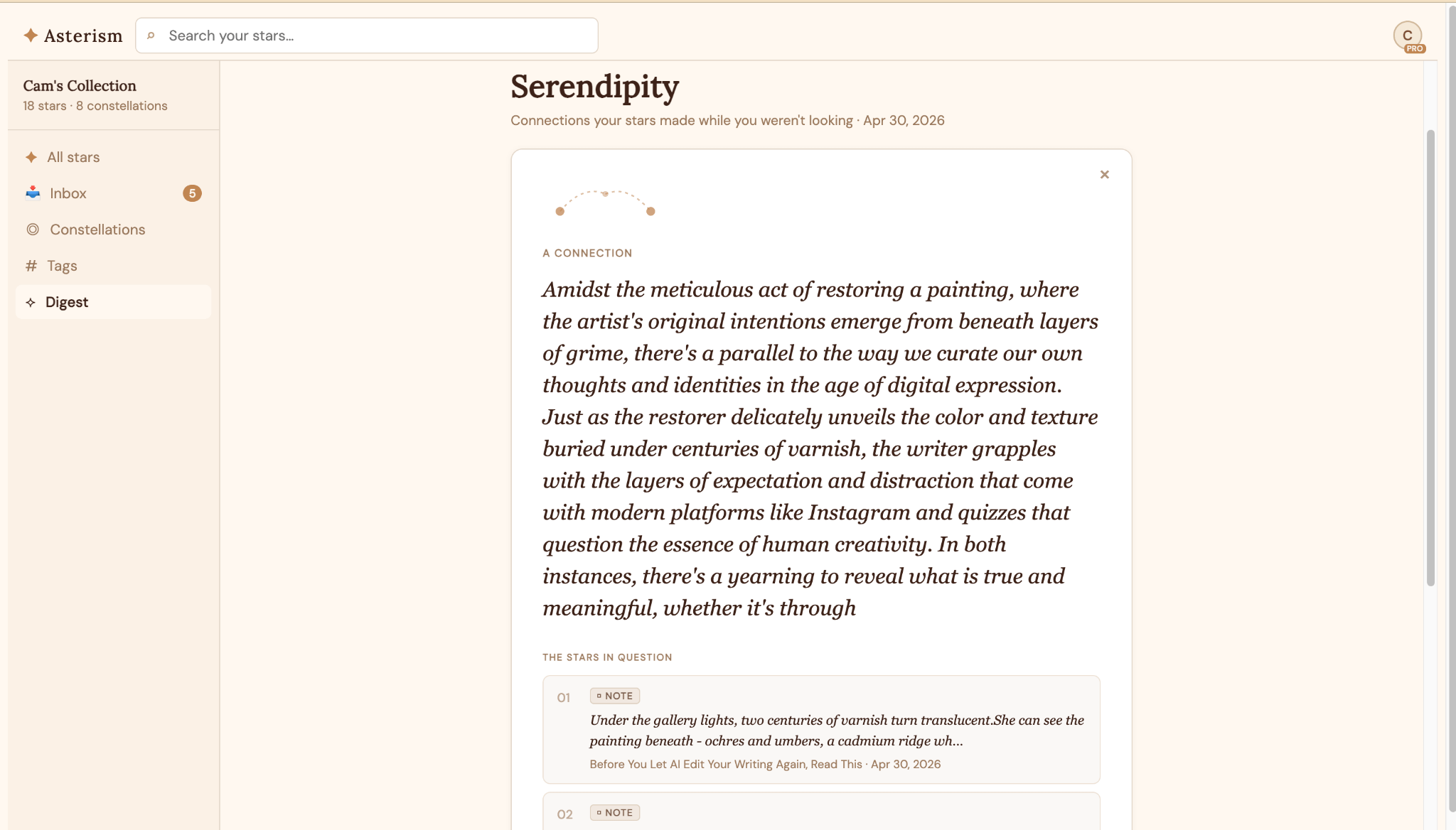
You don’t have to be disciplined about any of it. Visit it when you want to. Let it accumulate; the value compounds over time.
Final Note
Asterism is a solo-built app. I’m building it because I use it, and I think it should exist.
Furthermore, your data is yours. You can export it at anytime in Markdown or JSON. The AI features process your content to serve you, and your data is never used to train models. Pricing is $9/month or $72/year.
The free tier is genuinely free and valuable. Core capture, the Serendipity Digest, and constellations are all available without paying. Pro unlocks more, such as a discovery mode to uncover unexpected connections and unlimited constellation suggestions. I’d love for you to subscribe because it’s how I get to stay independent.
Join Asterism
If you like any of this, then you can join the waitlist at myasterism.com.